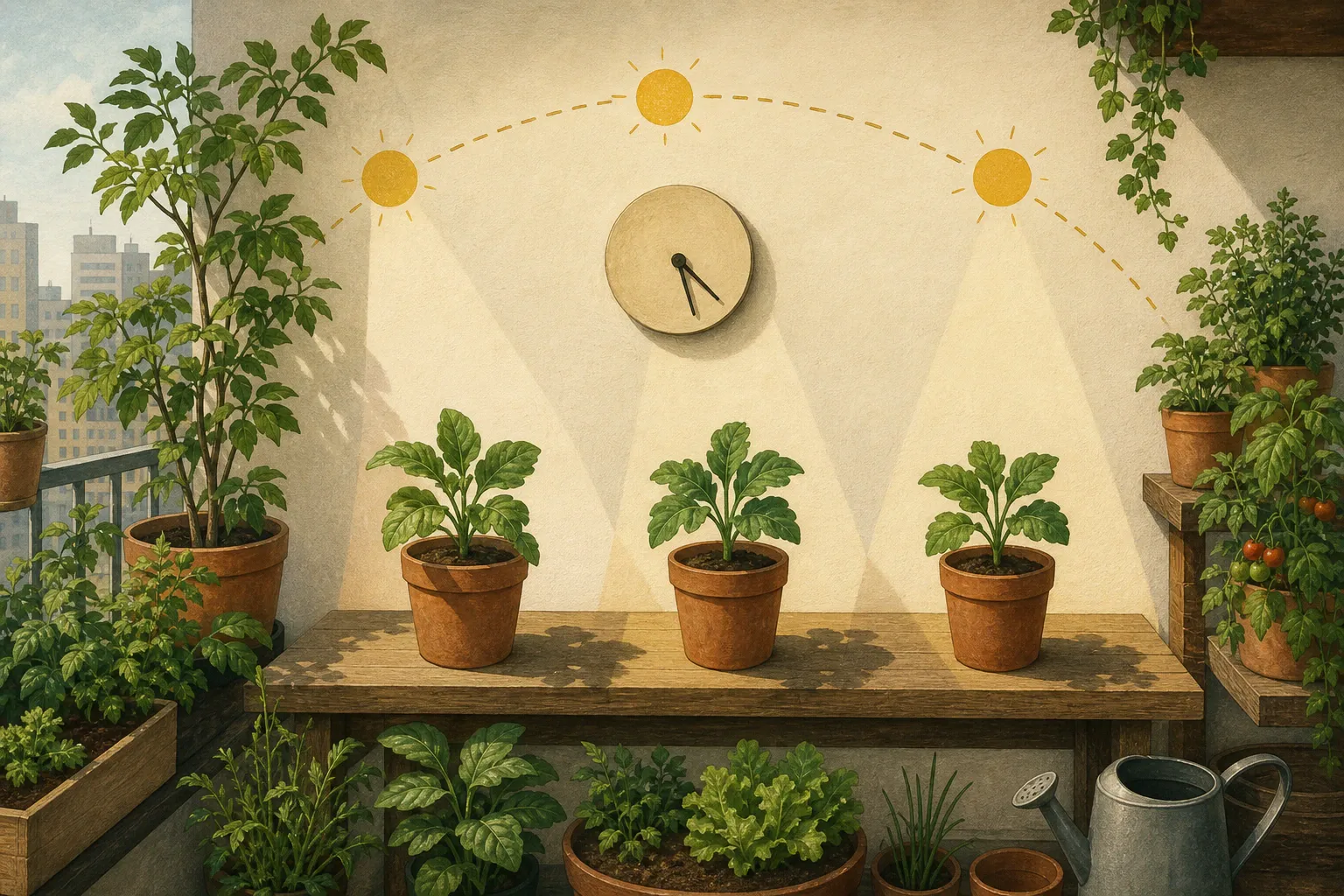
Fix the point before counting
Observe at the height and exact position of future leaves. A balcony overhang, fence, tree, neighbouring building or crop row can change exposure within a few metres.
Count direct sunlight only
Record intervals when direct sun reaches the point and forms a clear shadow. Bright sky, reflected light from glass or pale walls and long daylight do not equal continuous direct sun.
Add separate intervals instead of treating morning and evening brightness as one block.
Repeat during the actual season
Sun angle, deciduous leaves, new structures, shade material and the crop canopy change exposure. Repeat after a meaningful seasonal or site change.
Use a conservative band
One clear day or phone reading does not establish a permanent threshold. If the result lies near a planner boundary, choose the lower band and observe the plant response.
Sources, scope and limits
Sources support the stated context. They do not turn a broad guide into individualized advice or transfer rights to reproduce the original material.
New Zealand English home food garden editorial synthesis — version 1
Global Garden Planner
Original eight-profile model, Southern Hemisphere planting bands and en-NZ corpus. It remains an editorial draft until independent New Zealand agronomic review is recorded.
Common climate and weather terms
Earth Sciences New Zealand / NIWA
Supports separating climate, normals, weather and Southern Hemisphere seasons. It does not supply crop thresholds or planting dates.
Regional climatologies
Earth Sciences New Zealand / NIWA
Supports recognising substantial regional variation in rain, wind, temperature and topography. The eight project profiles and every month band are original editorial synthesis pending review.