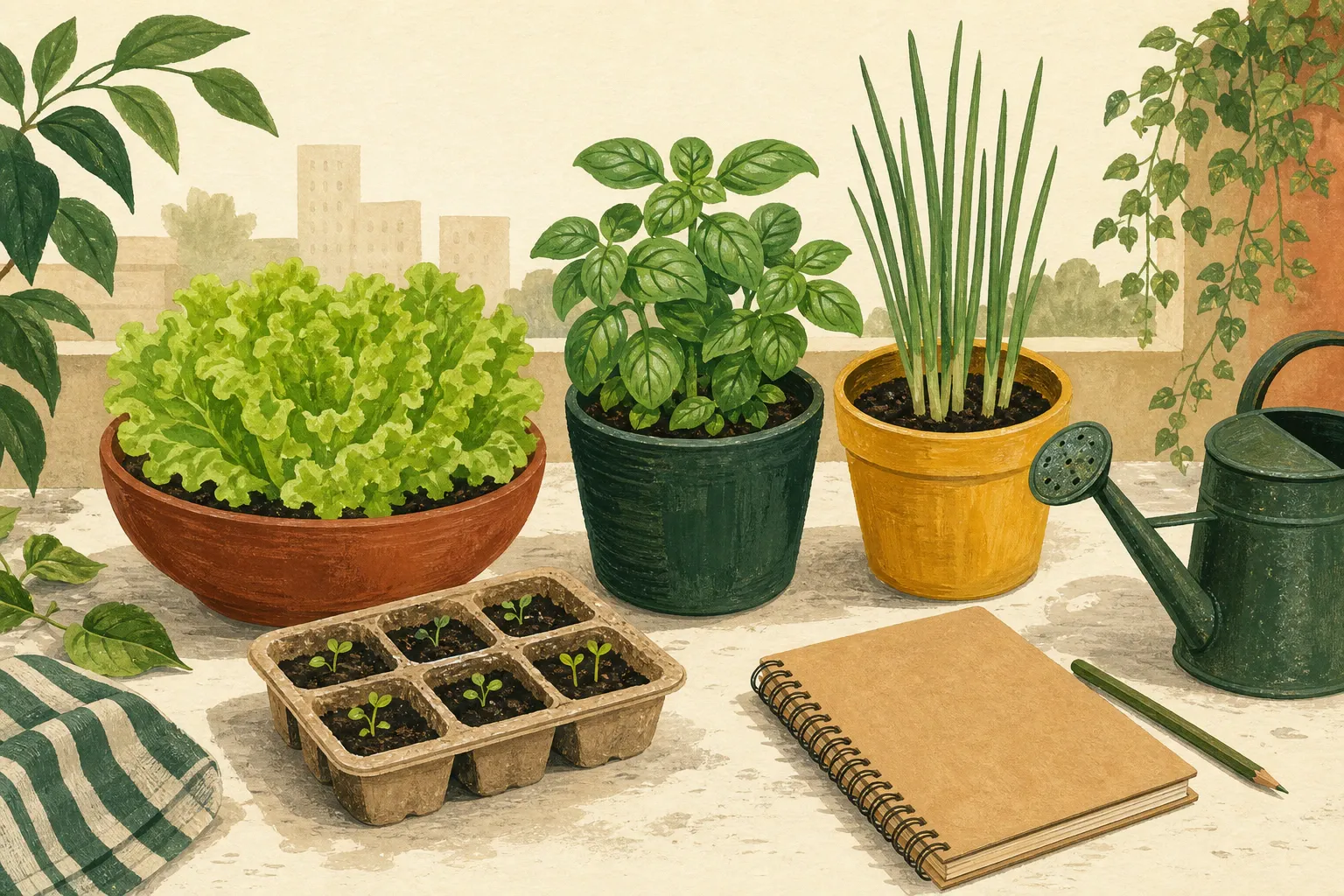
Begin with one final growing position
Choose the actual balcony corner, patio, raised bed, or ground plot before choosing crops. Record when direct sun reaches that point, where water leaves, how wind moves through it, and whether you can reach every container safely.
A bright room, sunny railing, or warm neighborhood does not prove that the planting position receives enough direct light or root volume.
Check boundaries before buying
Confirm landlord, homeowners-association, fire-access, balcony-load, irrigation, drought, and local plant-health rules that apply to the site. Do not block drains, exits, shared walkways, or utility access.
Use identified seed or plants from a reputable source. Imported or interstate material can carry restrictions even when it was easy to order online.
Choose a deliberately small first set
Start with two or three crops that fit the measured light, depth, and current season. A leafy crop, herb, and one fruiting crop are easier to compare than a full catalog planted at once.
Leave spare container volume and working room. Mature leaves, stakes, wet potting mix, and watering equipment all need space.
Record observations, not just outcomes
Note planting material, date, direct-sun band, watering checks, heat or frost events, pests, and harvest. A failed crop can still show whether the constraint was timing, light, water, support, or unsuitable material.
Use local expertise for the unresolved details
Cooperative Extension and official regional climate services can help with cultivar, county, elevation, frost, soil, and pest questions that a broad national profile cannot resolve.
Sources, scope and limits
Sources support the stated context. They do not turn a broad guide into individualized advice or transfer rights to reproduce the original material.
United States home food garden editorial synthesis — version 1
Global Garden Planner
Original seven-profile model and localized corpus. It remains an editorial draft until an independent U.S. agronomic review is recorded.
Vegetable Gardening
USDA National Agricultural Library
Supports the planning sequence of site selection, soil or mix preparation, planting, maintenance, and harvest, plus referral to Cooperative Extension.
Regional Climate Centers
NOAA National Centers for Environmental Information
Supports directing people to regional and local climate expertise rather than claiming that a national profile resolves a site.